Vipassana Meditation: What It Is and How It Works
TL;DR


Vipassana (Pali: vipassanā; Sanskrit: vipaśyanā) translates as "clear seeing" or "special insight" — the direct perception of reality as it actually is, rather than as filtered through conceptual overlay, habitual reactivity, and self-referential narrative.
The practice originates in the Theravada Buddhist tradition and is among the oldest systematically documented meditation methods. Its foundational textual source is the Satipatthana Sutta — the discourse on the four foundations of mindfulness — attributed to the historical Buddha and preserved in the Pali Canon. Where samatha practices (calming meditations) are primarily concerned with the stabilisation of mind, Vipassana is explicitly investigative: the stabilised mind is turned toward direct inquiry into the nature of experience itself.
What Are the Four Foundations of Mindfulness in Vipassana?
Vipassana is structured around four domains of observation: the body (kaya), feeling tone (vedana), mind states (citta), and mental objects and phenomena (dhamma). Each foundation is progressively more subtle than the last, revealing different layers of how experience is constructed and how the mind automatically reacts to it.
Kayanupassana (contemplation of the body) — systematic observation of physical phenomena: posture, movement, the mechanics of breathing, the arising and passing of bodily sensation. This foundation provides the most accessible entry point for most practitioners, anchoring investigation in direct physical experience.
Vedananupassana (contemplation of feeling tone) — observation of the hedonic quality that accompanies every moment of experience: pleasant, unpleasant, or neutral. This is not emotion — it is the more fundamental evaluative quality that underlies emotional response. Recognising feeling tone as it arises is essential to understanding the automatic mechanisms by which craving and aversion are generated.
Cittanupassana (contemplation of mind states) — observation of the quality and character of awareness itself: contracted or expansive, concentrated or diffuse, clear or obscured. The practitioner observes mind states without identification, developing the capacity to be aware of awareness rather than simply caught within it.
Dhammanupassana (contemplation of mental objects and phenomena) — observation of the arising and passing of specific mental contents and the principles that govern them: the five hindrances (desire, aversion, sloth-torpor, restlessness, doubt), the seven factors of awakening, and the three characteristics of all conditioned phenomena.
What Are the Three Characteristics That Vipassana Reveals?
Vipassana is designed to produce direct experience — not intellectual acceptance — of three facts: all phenomena are impermanent (anicca), clinging to impermanent things produces suffering (dukkha), and the stable self we take for granted is in fact a stream of constantly changing processes (anatta). These become perceptible through sustained observation, not through philosophical study.
Every sensation, without exception, arises and passes. No phenomenon — physical or mental — endures. The sense of a stable, continuous self that experiences events begins, under careful investigation, to dissolve: what we take to be "self" reveals itself as a stream of changing phenomena, observed by an awareness that is itself difficult to locate.
This investigation constitutes the central work of the practice. The clinical benefits commonly attributed to meditation — reduced anxiety, greater equanimity, improved concentration — are, in this framework, natural consequences of a mind that has begun to disentangle itself from its habitual patterns of reactivity. They are worth noting; they are not the point.
What Conditions Does Vipassana Require to Deepen?
Vipassana deepens in proportion to the continuity and depth of observation. Noble silence removes the constant re-engagement with social self-presentation that interrupts sustained inward attention. This is why retreat is considered essential by most serious practitioners — it provides the one condition daily life cannot reliably offer: uninterrupted continuity of practice.
Omunity's 6 Day Silent Retreat is structured around these conditions: six days of continuous practice, daily pranayama sessions to support mental stability, and a protected environment in which the work can proceed without the interruptions of ordinary life.
Frequently Asked Questions
What is the difference between Vipassana and mindfulness meditation?
Vipassana and mindfulness meditation share a common root in the Satipatthana Sutta and are closely related. The distinction is partly one of emphasis: mindfulness practice focuses on cultivating present-moment awareness as a quality that supports daily life and wellbeing. Vipassana is specifically investigative — it uses that awareness as a tool for insight into the fundamental characteristics of experience: impermanence, unsatisfactoriness, and non-self. In practice, the two often overlap substantially.
Is Vipassana a religious practice?
Vipassana originates within the Buddhist tradition, and its framework — the four foundations of mindfulness, the three characteristics, the Satipatthana Sutta — is Buddhist in structure. Contemporary secular presentations of Vipassana present it as a universal mental training technique available to practitioners of any background. Whether one engages with the Buddhist framework is a personal choice; the practice can be approached on its own terms without formal religious commitment.
What should I expect during a first Vipassana retreat?
Most practitioners report that the experience is simultaneously more difficult and more interesting than anticipated. The first few days typically involve confronting the mind's habitual restlessness and resistance to stillness — a discomfort that is itself part of the practice. As the retreat progresses, periods of greater clarity and depth become more frequent. Noble silence tends to become a valued support rather than a hardship.
Can Vipassana be practised at home without a retreat?
Daily home practice is both possible and valuable. However, the retreat environment provides conditions — continuity, silence, removal from ordinary demands, qualified guidance — that are very difficult to replicate independently. Most serious practitioners regard retreat as an essential complement to daily practice rather than an optional addition.
How long is a typical Vipassana retreat?
Traditional Vipassana retreats, as taught in the Goenka tradition, are ten days in duration. This is considered the minimum time required for the practice to begin producing genuine insight. Shorter retreats of five, six, or seven days — such as Omunity's 6 Day Silent Retreat — provide a meaningful introduction while remaining accessible to practitioners with limited time.
What we offer
From intensive teacher trainings to week-long retreats, we offer programs for every stage of your meditation journey.


200H Meditation & Pranayama Teacher Training
A 21-day intensive teacher training course designed to dive deep into consciousness and learn how to guide others. For yoga practitioners who want to dive deeper into meditation & pranayama and teach it.


Meditation Immersion Program
An intensive 12 day program to dive deep into yourself and discover who you are, through multi-style meditation & pranayama practice.
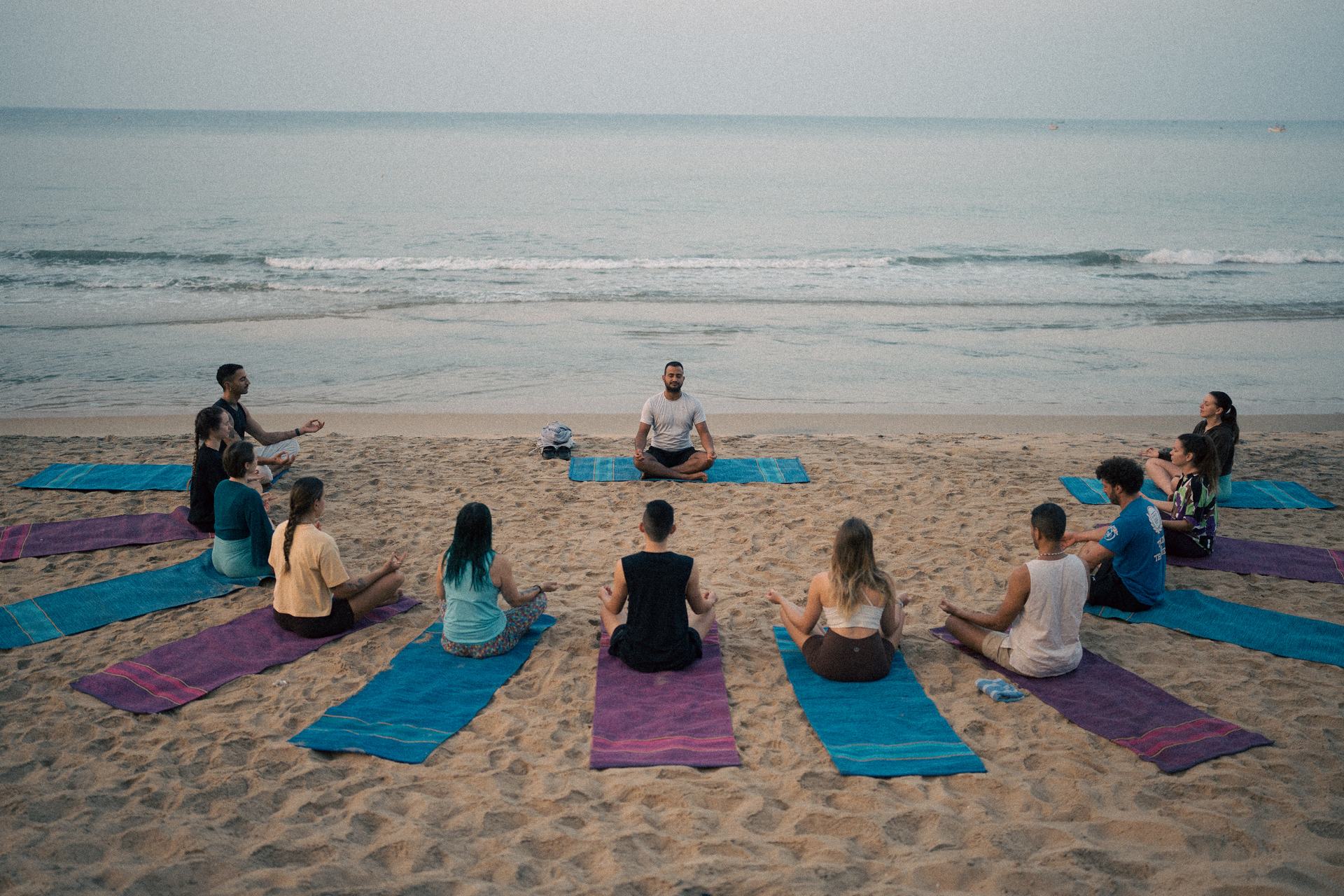

Meditation & Silence Retreat
Take 6 days off of modern life to get back to yourself. Through silence, meditation practice and creative exploration, you will reconnect with who you truly are.
Practice near the ocean and Jungle of Kerala
Omunity Meditation school located in Varkala, a serene cliffside town in Kerala, known for its unique mix of Ayurveda, yoga, beaches, and surf culture. Just minutes from our private campus, you’ll find golden sands, breathtaking cliffs and cosy cafés overlooking the Arabian Sea. Unlike India’s busier tourist hubs, Varkala offers a safe, welcoming atmosphere, ideal for yogis, travelers, and surfers looking for both peace and connection.